



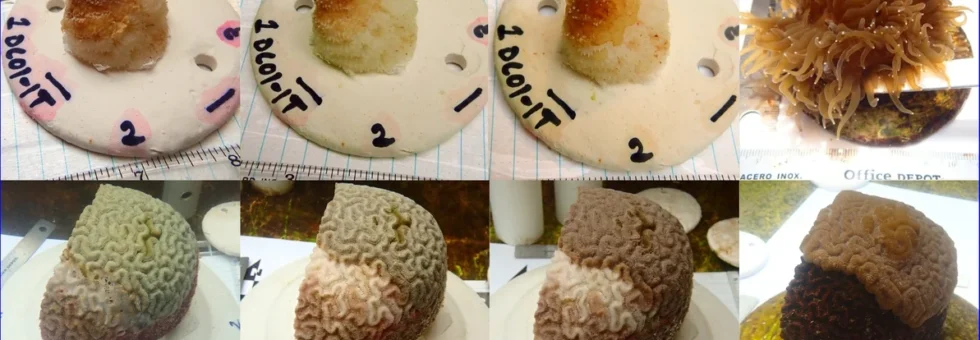
Photo: Adapted from Figure 2 Pelose et al. (2026), Frontiers in Marine Science.
Five coral species facing ex situ treatment
The scientific team of Grupo Iberostar, through its Wave of Change program, led a study to evaluate the effectiveness of a 10-day ex situ treatment protocol against Stony Coral Tissue Loss Disease (SCTLD) in five Caribbean coral species. The experiment was conducted at Iberostar's coral laboratory in Bávaro, Dominican Republic, with the collaboration of international researchers, including Dr. Johanna Calle-Triviño, Mexico's national representative to the Executive Committee of the Mesoamerican Reef Network (MAR Network).
The evaluated species were pillar coral (Dendrogyra cylindrus), great star coral (Montastraea cavernosa), symmetrical brain coral (Pseudodiploria strigosa), mountainous star coral (Orbicella faveolata) and lobed star coral (Orbicella annularis).Fragments with active SCTLD lesions were collected from three Dominican reefs and individually sealed underwater to prevent contamination during transport to the land-based facility. There, 30 genotype-labeled fragment pairs were randomly assigned to two open 230-gallon tanks (one treatment, one control), supplied with saline well water, continuous flow, natural light, and daily Reef Roids feedings.

Photo: Adapted from Supplementary Figure 2 from Pelose et al. (2026), Frontiers in Marine Science.
Treatment and Results
- •By day 26, 93% of the treated fragments (28 of 30) remained alive and showed no reinfection for 352 days.
- •In contrast, only 30% of untreated controls survived until day 26.
- •When applying the treatment late to the 9 surviving controls, all managed to survive (100%) and showed no reinfection for 336 days.
- •On day 26, survival was 100% in Montastraea cavernosa, Orbicella annularis, and Orbicella faveolata, and 67% in Pseudodiploria strigosa.
- •In Dendrogyra cylindrus, survival was 93% with treatment compared to 36% without treatment.
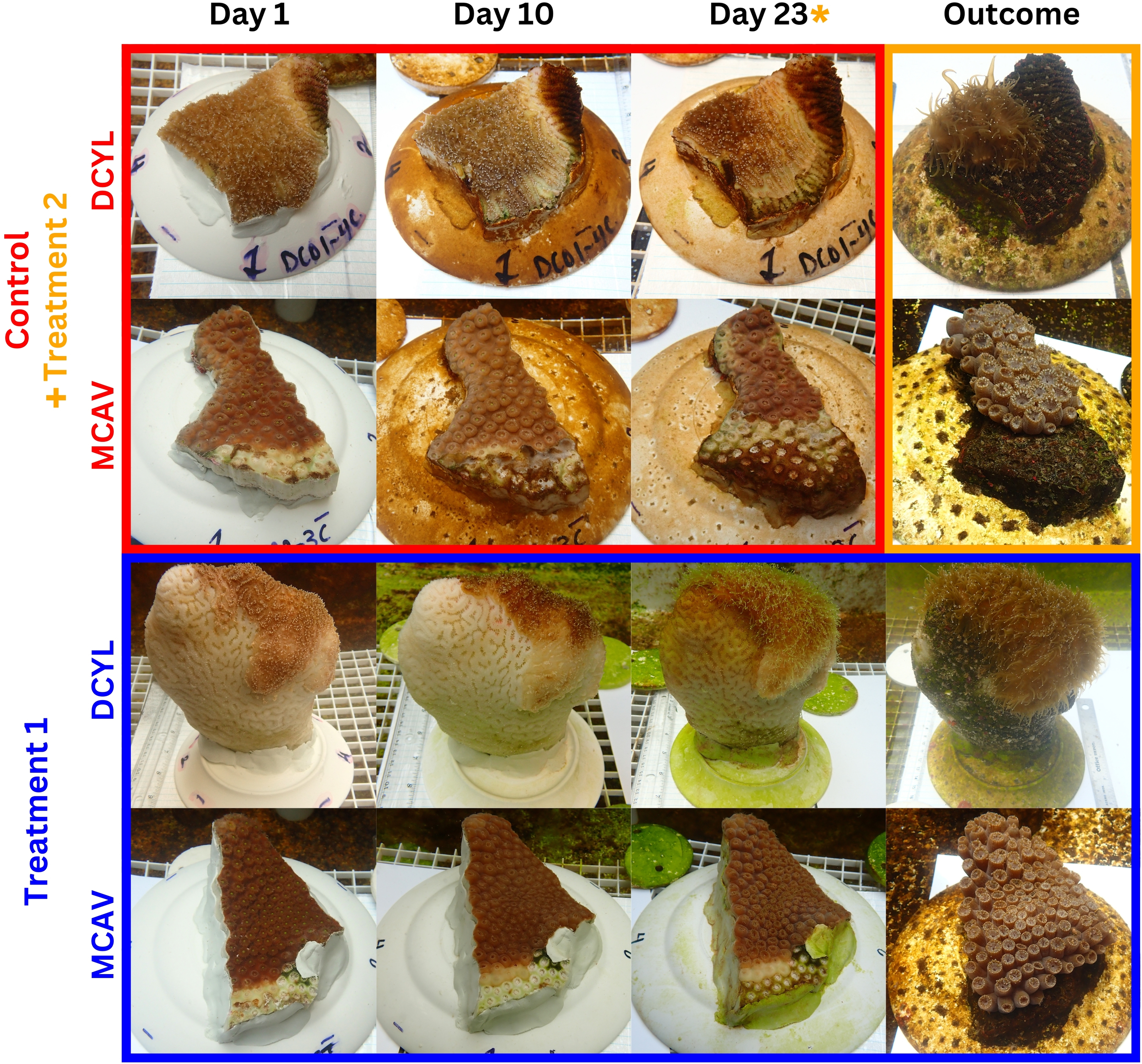
Photo: Control fragments that received delayed treatment (day 26) and their counterparts treated from the start, with their recovery at nearly one year. Adapted from Figure from Pelose et al. (2026), Frontiers in Marine Science.
Scope and Challenges of Treatment
This comprehensive protocol emerges as a promising tool for managing SCTLD outbreaks in ex situ restoration facilities. It effectively halted the disease, with no reinfections for 352 days, even in small fragments (from 6.51 cm²) or with delayed treatment. Additionally, it enabled the rescue of diseased tissue from critically endangered species, such as Dendrogyra cylindrus, thus saving genotypes lost in local reefs without extracting healthy colonies from the reef.
However, the method still has limitations. Its effectiveness could be related to both fragment size and the proportion of remaining healthy tissue, aspects that require further research. So far it has only been validated on land, so future studies are needed to adapt it to the reef, isolate the individual effect of each component (cleaning, disinfectants, and antibiotics), and assess its impact on the microbiome and resistance to new exposures.
References
Author: Comunicaciones RRA-SAM Scientific review: Dra. Johanna Calle-Triviño
Photo credits: Pelose et al. (2026), Frontiers in Marine Science
Copyright © 2026