



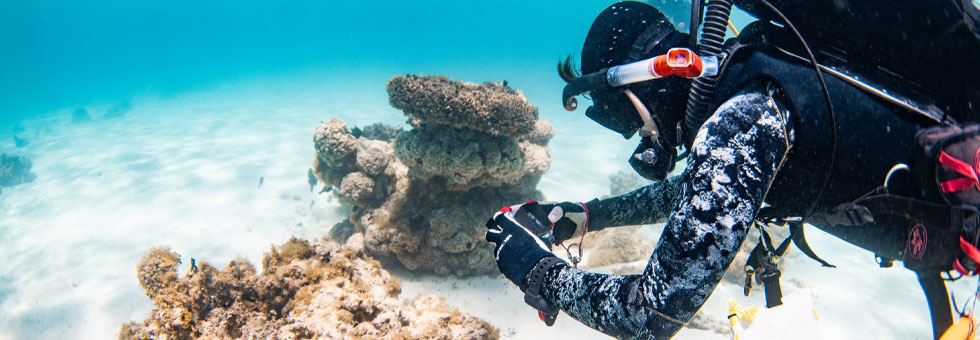
Photo: Vee Brosig/Blue Media.
‘Deathly silent’: two out of three corals in world heritage-listed Ningaloo reef have been killed, scientists confirm
One expert says she is ‘starting to visualise the point where all we have left of corals and reefs is memories’
Almost two out of three corals across popular tourism spots at the world heritage-listed Ningaloo reef died after an unprecedented marine heatwave hit the Western Australia region, scientists have said. The areas in Ningaloo’s northern lagoon had undergone a “profound ecological simplification” with coral species that were keystones to the habitat among those killed.
The marine heatwave swept across the Western Australian coastline last summer and autumn, turning corals white from heat stress from Ningaloo to Ashmore reef 1,500km to the north-east. When corals sit in unusually warm water for too long they separate from the algae that give them much of their colour and nutrients, leaving behind a translucent flesh revealing the white skeleton behind. About 90% of the extra heat on the planet has been taken up by the ocean. The heating is caused when greenhouse gases are released from burning fossil fuels and cutting down forests.
Unprecedented marine heatwave decimates corals at Ningaloo reef
The bleaching was so confronting because it was so expansive
Coral scientist Zoe Richards, an associate professor at Curtin University, had in March surveyed 1,600 individual corals at eight sites spanning 40km when the bleaching event was peaking.
“The bleaching was so confronting because it was so expansive,” she said.
Other scientists who visited Ningaloo during the mass coral bleaching spoke of their shock at the extent of the heat and the suffering of the corals.
When Richards, who carried out the work in partnership with the Minderoo Exmouth Research Laboratory, returned with Curtin University researcher David Juszkiewicz at the end of October, about 1,000 of the 1,600 corals she had recorded had died.
She said: “You go in hoping the corals you saw that were partially bleached might have recovered.
Unfortunately the scale tipped to mortality. Most of the data is showing that any coral that bleached in March went on to die.”
‘Incredible places’ The areas surveyed were between the Osprey and Tantabiddi sanctuary zones and cover the northern parts of the Ningaloo lagoon that are popular with tourists, Richards said.
Diving and snorkelling on these reefs, Richards said, was usually accompanied with “lots of popping and cracking” sounds of fish and other animals.
“It was deathly silentshe said. “The only animals that looked happy were the sea cucumbers. They are the detritus-eaters.”
Fourth mass bleaching
The loss of corals at Ningaloo was part of the fourth and worst global mass bleaching event on record that exposed more than 80% of reefs in more than 80 countries to temperatures high enough to cause bleaching.
The loss of corals at Ningaloo was part of the fourth and worst global mass bleaching event on record that exposed more than 80% of reefs in more than 80 countries to temperatures high enough to cause bleaching. Some scientists have claimed global heating has already pushed tropical coral reefs to a tipping point of long-term decline. “Corals act like thermometers for the ocean,” Richards said. “When they bleach, they are sending out a clear signal that the temperature is too high. They don’t talk, but they are signalling to us very clearly. We’re on the brink of catastrophic ecosystem decline. This happening everywhere.
It’s just really depressing
I have devoted my whole life to coral research. I am starting to visualise the point where all we have left of corals and reefs is memories.
Source:
Press release link: ‘Deathly silent’: two out of three corals in world heritage-listed Ningaloo reef have been killed
Photo ©: Vee Brosig/Blue Media
Copyright © 2025 The Guardian. All rights reserved.