



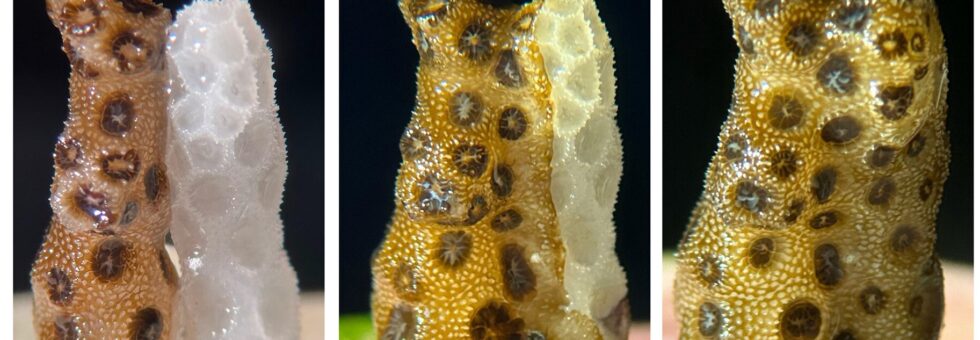
Photo: Adapted from Figure 3B Collins et al. (2026), Science Advances.
Under the microscope: when a healthy coral fragment touches a bleached one
A team from the Hopkins Marine Station at Stanford University published the study, Rapid coral bleaching recovery via symbiont transfer from healthy corals, which explores whether a small fragment of healthy coral can help a bleached coral recover, something little studied until now. Her idea was to take advantage of direct contact so that the healthy coral helps the bleached one regain the symbiotic microalgae (zooxanthellae) it lost, which provide most of its food (Collins et al., 2026). This approach is novel as it offers a fundamental framework for a method that shows complete recovery and could help accelerate the recovery of post-bleaching coral.
What the Experiment Revealed
In the laboratory, with fragments of cauliflower coral (Pocillopora damicornis), formed pairs of one healthy fragment and one bleached fragment and compared what happened with and without contact. They also tested pairs from the same genetic individual (clones) and from different individuals.
- •Those that touched a healthy one received their symbionts (zooxanthellae) and recovered completely, which took about seven weeks. This showed the polyp fully recovered in only 4 weeks with little algal growth. Those that had no contact suffered excessive external algal overgrowth and mortality.
- •One week of contact was enough to transfer symbionts to the bleached coral fragment, and even after separating them, the bleached coral completed its recovery on its own. 20 weeks later during the reassessment, there was greater polyp growth with new branches.
- •The symbionts transfer when tissues fuse and multiplied rapidly within the bleached coral, according to the study, doubling every four days in the second week.
- •It only worked between clones; however, among genetically distinct individuals there were antagonistic interactions and the healthy coral ended up invading the bleached one.
- •The limitations of clones regarding massive symbiont transfer and recovery observed in the experiment is determined by the coral, rather than by the symbionts.
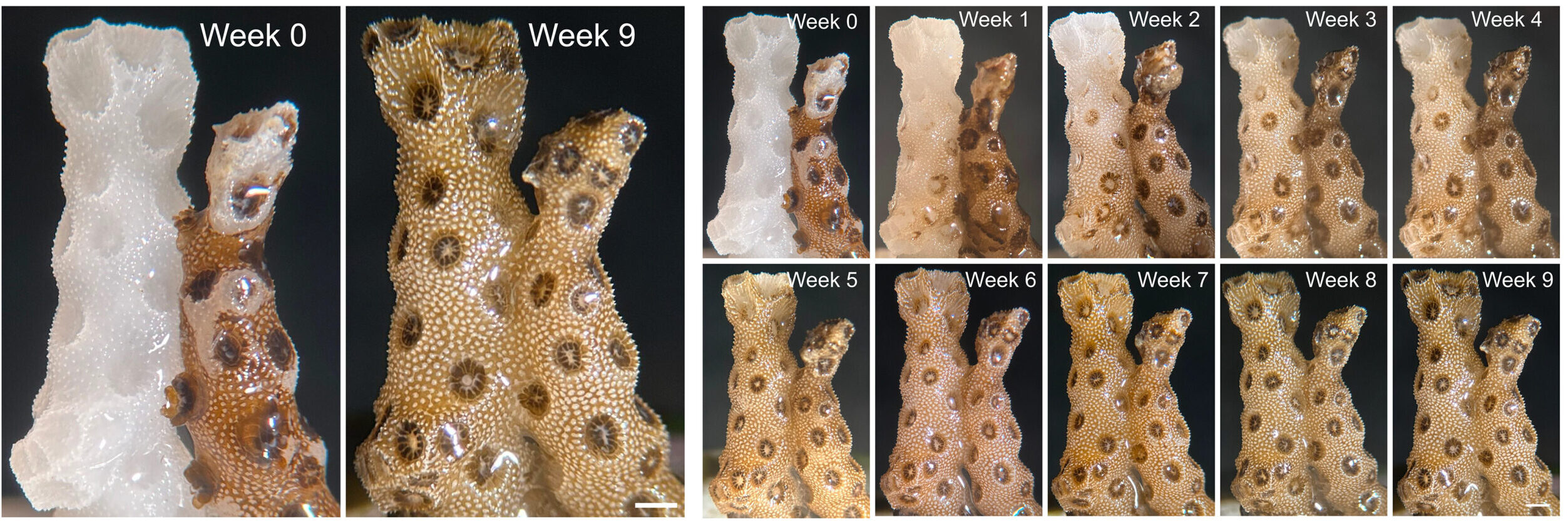
Photo: Figure 1A Examples of stereoscopic images of a bleached and healthy coral fragment (P. damicornis) in direct contact, Collins et al. (2026), Science Advances.
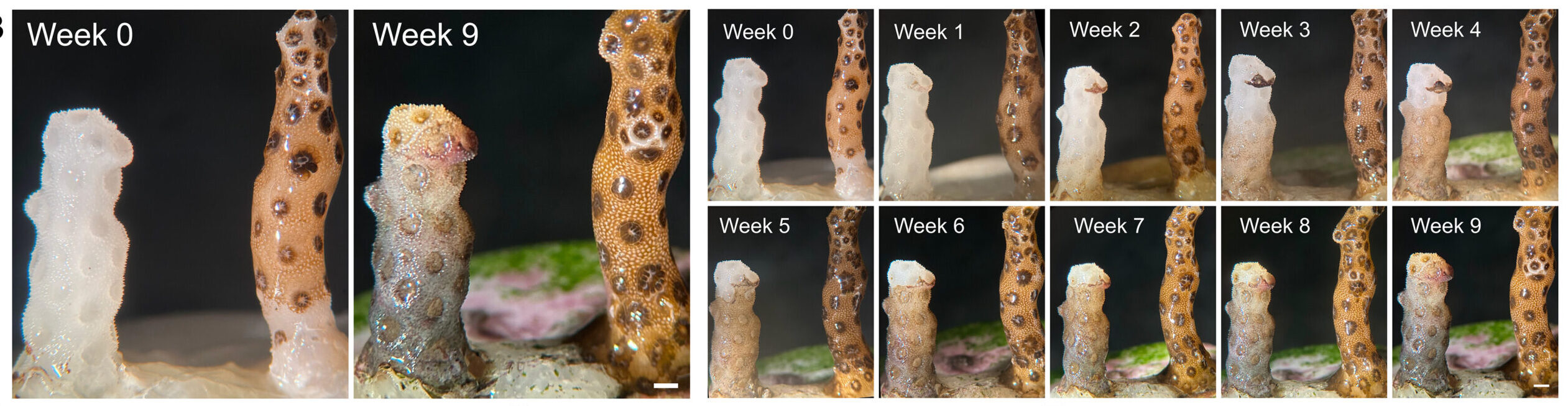
Photo: Figure 1B Example of stereoscopic images of a bleached and healthy coral fragment (P. damicornis) without contact, Collins et al. (2026), Science Advances.
Considerations from Aquarium to Reef
This was a controlled experiment conducted in a laboratory with fragments of a single species; it is unknown whether the same occurs in other species or under reef conditions. The method requires a healthy clone of each bleached coral, something the researchers themselves consider unfeasible at reef scale.
The team proposes future research on this recovery phenomenon in other species and forms of corals, symbionts, as well as their rapid population expansion and symbiont transport. The researchers suggest that the efficiency and scale of symbiont acquisition could provide a strategy and responsible mechanisms to reintroduce symbionts to bleached corals from healthy corals of different clones.
References
Collins, D. S., Sipkova, J., Mollica, N. R., Rolander, T., Klepac, C. N., Calistro, G. F., Barone, V., Micheli, F., & Palumbi, S. R. (2026). Rapid coral bleaching recovery via symbiont transfer from healthy corals. Science Advances. https://www.science.org/doi/10.1126/sciadv.aeh1580
Author: © Science Advances, RRA-SAM Comunicaciones
Photo Credits ©: Collins et al. (2026), Science Advances
Copyright © 2026