



Photo ©: Gemini AI
Summary
Stony coral tissue loss disease (SCTLD) has caused unprecedented coral mortality in the Florida Coral Reef (FCR) since 2014. As the disease transitioned from epizootic to enzootic, we conducted a large-scale experimental transplant to evaluate the effectiveness of coral restoration under chronic disease persistence.
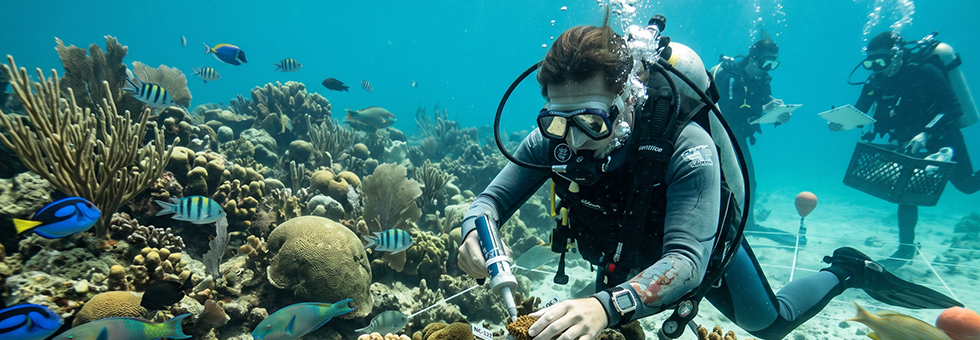
From May 2021 to April 2023, we transplanted 1165 colonies of three SCTLD-susceptible species (Montastraea cavernosa, Orbicella faveolata, Pseudodiploria clivosa, from land-based facilities and marine nurseries) across six regions spanning the FCR and monitored survival and disease incidence. Concurrent surveys of natural coral communities assessed whether transplant activities affected local SCTLD prevalence. Infection probabilities per monitoring interval remained <1-2% across all species, regions, and propagation sources throughout the monitoring period. Importantly, transplant activities did not increase SCTLD prevalence in adjacent natural coral communities.
The overall survival rate of coral colonies at the end of the study was 77.3%. Survival rates were strongly influenced by reef stratum (nearshore reefs versus offshore reefs), geographic region, and colony source. Montastraea cavernosa and P. clivosa showed substantially higher survival at nearshore sites compared to offshore sites, while O. faveolata showed no consistent effect of reef stratum on survival. Across the FCR, transplant survival varied spatially among regions independent of the latitudinal gradient, suggesting local or habitat-specific environmental factors. Colony source effects varied by species. M. cavernosa and P. clivosa from land-based facilities showed significantly lower survival compared to ocean-based nurseries, while O. faveolata showed no significant differences between propagation sources.
These findings demonstrate that coral restoration can be effectively conducted within SCTLD enzootic zones, but success depends on strategic site selection that matches species habitat preferences, optimization of propagation protocols across different nursery systems, and implementation of adaptive management approaches that address the multiple factors driving coral mortality beyond SCTLD prevalence.
Source:
Press release link: Assessing the efficacy of coral restoration along Florida’s Coral Reef under the chronic persistence of Stony Coral Tissue Loss Disease
Author: © 2026 Sharp, Parsons, Muller, Bourque, Gilliam, Lirman, Shea, Voss and Hunt.
Photo ©: Gemini AI
Copyright © 2026