



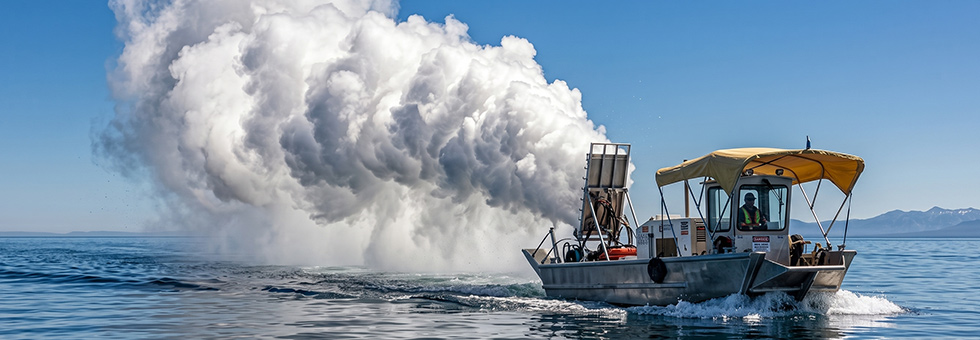
Photo ©: Gemini AI
Summary
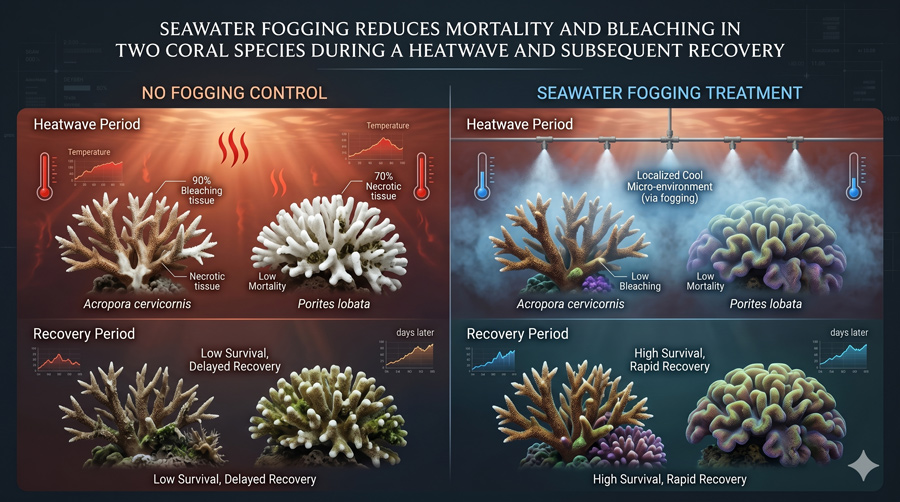
The increasing frequency and severity of marine heatwaves are driving factors of mass coral bleaching, requiring rapid emissions reductions and the development of scalable intervention tools. Shading corals to reduce irradiance stress is a promising approach; however, most studies focus on static structures and few include recovery dynamics. Here, we tested the efficacy of a laboratory-scale seawater misting system as a shading intervention during a simulated thermal/light stress and recovery experiment.
An orthogonal design with two temperature levels (control (26.5 °C) vs heat stress ((MMM) at the collection site, 29.1 + 3.7 °C) and two light treatments (misted, 33.3% shading ± 6.46 SD for 6 h daily vs non-misted) was used to test the response of Acropora hyacinthus and Pocillopora damicornis during 13 days of heat stress (3 degree-weeks C °) followed by a 24-day recovery period. Variable shading from seawater mist reduced mortality risk in heat-stressed A. hyacinthus by 55%. Only two mortalities occurred in P. damicornis, both in the heat stress treatment without mist. Misting reduced the percentage of bleaching and improved Fv/Fm in both species, beginning at 0.84 degree-weeks °C, with effects peaking near 3 degree-weeks °C.
Misting during the recovery period did not inhibit coral recovery, but provided some additional benefits, including an increase in Fv/Fm and lower catalase activity. Seawater mist can not only be used to delay/reduce bleaching while thermal stress is high, but can also enhance post-stress recovery and repair processes in corals. To promote seawater misting as a practical intervention tool on reefs, engineering advances must be accompanied by in situ testing that captures complex interactions between corals and the environment and assesses whole-ecosystem responses.
Buoyancy control is essential to protect corals (Coral Restoration Foundation™)
Source:
Press release link: Seawater fogging reduces mortality and bleaching in two coral species during a heatwave and subsequent recovery
Author: Hendrickson, Kyle, Butcherine, Harrison and Kelaher.
Photo ©: Gemini AI
Copyright © 2026 Hendrickson, Kyle, Butcherine, Harrison and Kelaher.