



What is happening?
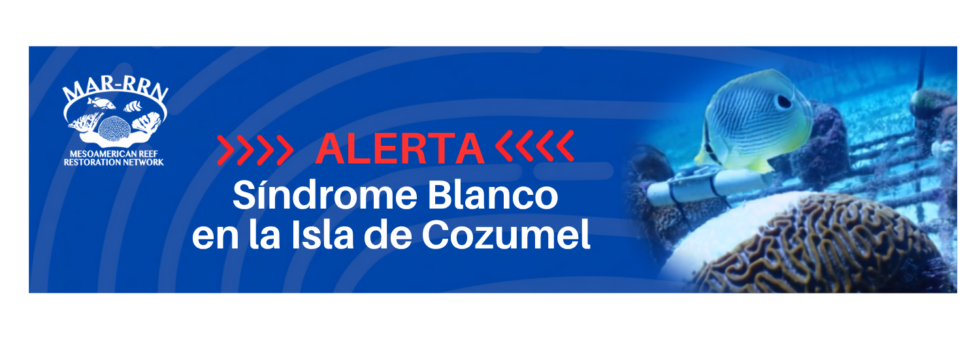
Sightings of Stony Coral Tissue Loss Disease (SCTLD, known in the Mexican Caribbean as White Syndrome) have been recorded at monitoring sites on the reefs of Cozumel, Quintana Roo, in colonies of symmetrical brain coral (Pseudodiploria strigosa) and maze coral (Meandrina spp.). In response to this resurgence, Johanna Calle, representative of the Mesoamerican Reef Restoration Network (RRA-SAM) in Mexico, calls on Network members to remain vigilant at their work sites.
SCTLD has been documented in the Mexican Caribbean since 2018, initially in Puerto Morelos Reef National Park, spreading along the entire Mexican Caribbean coast. The disease has affected more than 20 species of stony corals, with particularly severe impact on reef-building species such as brain corals (Pseudodiploria, Colpophyllia), massive corals (Orbicella spp., Montastraea cavernosa), and pillar coral (Dendrogyra cylindrus), a species listed as critically endangered by the IUCN.
Actions Taken to Date
Following verification of the disease's presence at affected monitoring sites, steps have been taken in accordance with the framework of the Action Plan for White Syndrome in Caribbean Reefs of Mexico. This has included sharing ex situ treatment protocols for affected colonies. This 10-day treatment, which consists of physical cleaning, disinfection with hydrogen peroxide, and an antibiotic bath, has reported up to 94% survival in treated colonies, with no reinfection during more than one year of follow-up. Additionally, Network members have been notified in coordination with the regional monitoring network (CONANP, HRI, UNAM-BARCOLAB) to track the evolution of the outbreak.
Recommendations
For the tourism, fishing, and conservation sectors, it is recommended to disinfect equipment, wetsuits, and vessels between dive sites, especially when leaving areas with confirmed SCTLD before visiting a healthy site, following the biosecurity guidelines of the Perry Institute for Marine Science, using sodium percarbonate or diluted chlorine for equipment, minimum 5-minute soak, and freshwater rinse.
More Information and Sighting Reports
In case of finding suspicious lesions, you can share a photo and location if possible, via email info@coralmar.org and johanna.calle@iberostar.com
Information Sources
Comisión Nacional de Áreas Naturales Protegidas, Proyecto Manejo Integrado “De la Cuenca al Arrecife” de la Ecorregión del Arrecife Mesoamericano. (2019). Plan de acción del síndrome blanco en arrecifes del Caribe Mexicano (C3-MAR2R-DOCTEC-001-2019). CONANP.
Pelose, G., Blanco-Pimentel, M., Calle-Triviño, J., Leon, A., Galván, V., Schopmeyer, S., Foster, D., Harms, E., Burdett, C., & Morikawa, M. K. (2024). Novel ex-situ stony coral tissue loss disease treatment protocol. protocols.io. https://dx.doi.org/10.17504/protocols.io.dm6gpzknplzp/v1
Pelose, G., Calle-Triviño, J., León, A., Schopmeyer, S., Galván, V., Stoner, A., Burdett, C., & Blanco-Pimentel, M. (2026). Ex situ treatment enhances survival and recovery from stony coral tissue loss disease in Caribbean corals. Frontiers in Marine Science, 13, Artículo 1672272. https://doi.org/10.3389/fmars.2026.1672272
Perry Institute for Marine Science. (s.f.). Detén la propagación de la enfermedad pérdida de tejido en corales duros [Infografía]. Perry Institute for Marine Science.
Author: © 2026 RRA-SAM Communications
Photo ©: Rodrigo Núñez, Cozumel Coral Reef Coalition
Copyright © 2026